How Technology Drives the Growth of Outdoor Advertising
Technology is revolutionizing outdoor advertising, enhancing its effectiveness and reach, especially in Latin America.
What is the greatest strength of outdoor advertising?
According to Billboard Insider readers, the barriers to entry (44%) and high cash margins (40%). Technology ranks third, with only 8%.
Scroll to see all columns
| Greatest strength of OOH | Percentage of readers |
|---|---|
| Barriers to entry | 44% |
| High cash margins | 40% |
| Technology creates growth potential | 8% |
These fundamentals are real. Premium locations are scarce, permits are costly, and a well-managed billboard network generates cash. But they describe a protected medium, not a growing one. Technology is what turns a protected asset into a growing asset.
How much has outdoor advertising grown in the last decade?
Between 2015 and 2025, outdoor advertising revenues in the U.S. grew by $2.2 billion (+30%). During the same period, magazines lost 56%, newspapers 44%, and radio 17%. No other traditional medium grew.
Scroll to see all columns
| Medium | Revenue change 2015-2025 (U.S.) |
|---|---|
| Outdoor advertising | +30% ($7.3B to $9.46B) |
| Television | 0% ($73B to $73.3B) |
| Radio | -17% ($14.7B to $12.2B) |
| Newspapers | -44% ($18.8B to $10.6B) |
| Consumer magazines | -56% ($16.8B to $7.4B) |
Source: Billboard Insider, October 7, 2026. U.S. advertising revenues by medium.
The gap is closing quickly. In 2015, newspapers were 2.6 times larger than OOH. By 2025, only 1.1 times. Today, OOH is already larger than consumer magazines.
The reason is simple. Online took revenue from newspapers and magazines. Streaming fragmented TV audiences. Digital and satellite audio took listeners from radio. Streets, shopping malls, airports, and subways remain places where people look up.
How does technology generate growth in outdoor advertising?
Technology drives OOH on four fronts: more inventory, smarter buying, better measurement, and lower costs.
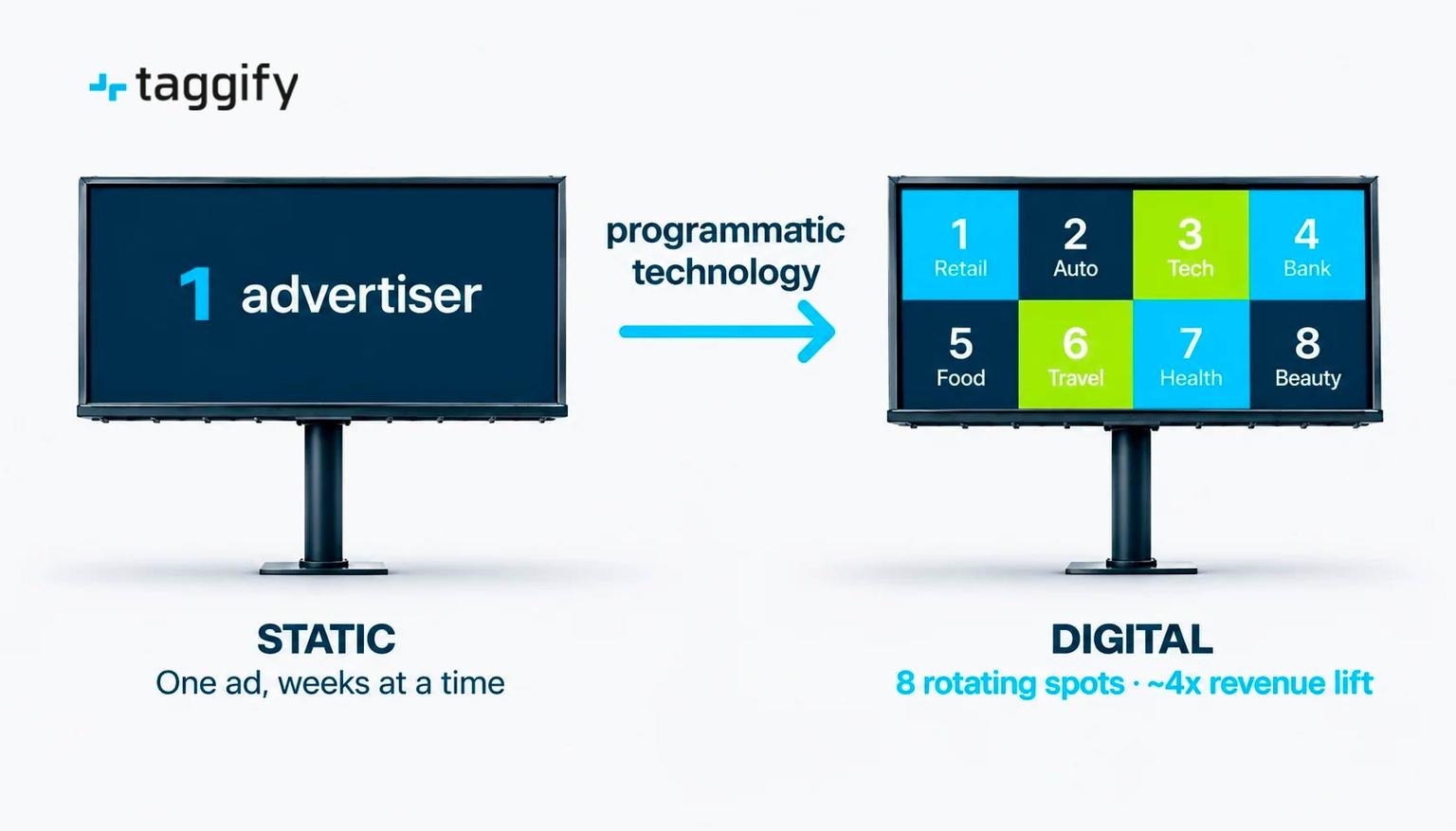
- Digital screens multiply inventory. A static billboard sells one ad at a time. A digital screen rotating eight spots sells eight, with the same structure and in the same location. Billboard Insider estimates each new digital screen multiplies revenue by four.
- Programmatic buying makes each screen purchasable. Multiplying spots only creates value if someone buys them. Programmatic DOOH connects screens with the same automated demand that buys online media. Advertisers buy by audience, time slot, weather, or location. They launch in hours, not weeks. And they pay only for the impressions they get.
- Measurement is faster and more accurate. Traditional impact models update slowly. New data sources, like mobility, traffic, and camera audience counting, allow impacts to reflect who actually passes by a screen at any given time. This way, OOH can be compared and planned alongside digital channels.
- Operation becomes cheaper. LED lighting reduces energy costs. Remote monitoring detects outages without sending a truck. Content goes live from a control panel, not from an installed canvas.
What does this mean for Latin America?
Latin America has the screens. The opportunity now is to connect them. Digital panels are multiplying from Mexico City to Bogotá, Lima, São Paulo, Santiago, and Buenos Aires. But much of that inventory is still sold manually, network by network. This leaves screen time unsold and keeps international programmatic budgets out of reach.
Taggify was born to close that gap. Our platform brings together all layers of programmatic DOOH:
-
DSP: for advertisers and agencies to plan, buy, and optimize campaigns across networks and countries from a single place.
-
SSP: for media owners to open their screens to automated demand, set floor prices, and fill unsold time.
-
DMP: to segment screens by audience, location, and context with first-party and third-party data.
-
DCO: to change creativity in real-time based on weather, time, location, or live data.
Today, Taggify connects inventory in 14 countries: Mexico, Guatemala, El Salvador, Honduras, Costa Rica, Panama, Colombia, Ecuador, Peru, Brazil, Paraguay, Uruguay, Chile, and Argentina. A brand can launch a single campaign from Mexico to Patagonia. And a media owner can reach buyers far beyond their own sales team.
Frequently Asked Questions
What is programmatic DOOH? It is the automated purchase of digital outdoor advertising screens. It allows segmentation by audience, time, weather, or location, launching in hours and paying for the impressions obtained.
Why is outdoor advertising growing compared to other media? Because technology multiplies inventory per screen, improves measurement, and lowers costs. And because the street is still a place where people look. In the U.S., it grew by 30% between 2015 and 2025.
What does a media owner need to sell their screens programmatically? Connect them to an SSP. This way, they open their inventory to automated demand, set floor prices, and fill the time that remains unsold today.
Conclusion
Barriers to entry and good margins protect outdoor advertising. Technology is what makes it grow.
• For advertisers: DOOH offers the reach of a mass medium with the targeting, flexibility, and accountability of digital.
• For media owners: each screen not connected to programmatic demand leaves revenue on the table.
Want to put technology to work on your screens or your next campaign? Talk to our team.
Physical spaces. Smart media.
Source: Out of Home Strength: Technology Creates Upside, Billboard Insider, October 7, 2026.
More ideas for programmatic DOOH teams
Continue with practical reads on audience intelligence, inventory strategy and measurable real-world media.
Audiences don’t live in a prompt
AI can interpret a brief, but understanding an audience in the physical world requires data, signals and measurement models. Metrica connects intent with actionable evidence for programmatic DOOH.

Automation in Outdoor Advertising: How Programmatic Drives Efficiency and Simplifies Processes
Traditional out-of-home (OOH) advertising has historically been one of the most powerful and accessible channels in the advertising ecosystem. However, launching a campaign on the street used to involve a lengthy process: phone calls, email chains, lengthy negotiations, and little flexibility for optimization. Today, thanks to automation and programmatic buying (pDOOH), out-of-home advertising has evolved. We explore how pDOOH enables advertisers to plan, launch, and optimize campaigns in minutes through automation, cost efficiency, and actionable data.
pDOOH: Building Brand Trust in a Saturated Environment
Trust is one of the most decisive assets for brands. It is not just an intangible value: it is the reason consumers choose a brand and are willing to pay more for its products. In a context where attention is scarce and advertising credibility is being questioned, Programmatic Out-of-Home Advertising is an effective medium for strengthening the relationship between brands and people.