In the Attention Economy, Out of Home Has an Unfair Advantage
Out of Home advertising excels by capturing real-world attention, offering unique advantages in the fragmented media landscape.
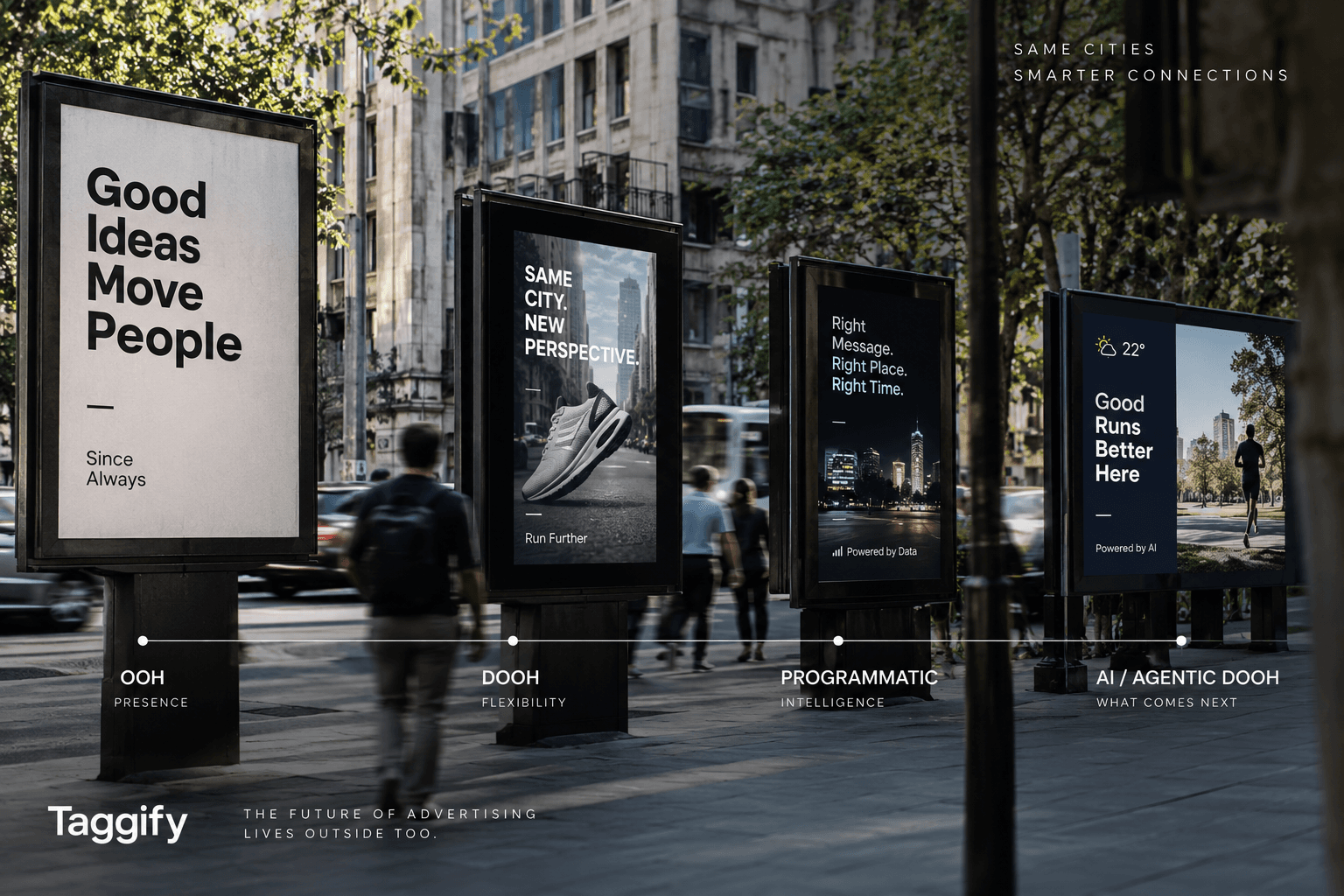
Consumers now move through an increasingly fragmented media environment, switching between feeds, streaming platforms, websites, apps and devices. Advertising competes not only against other advertising, but against virtually every piece of content available to a person.
This changes the equation.
The next challenge for advertising isn’t generating more impressions.
It’s making impressions matter.
And this is where Out of Home has a structural advantage.
You can’t scroll past the physical world
A billboard doesn’t compete for space inside a feed.
A screen in an airport, subway station, shopping mall or city center exists in the environment around us.
It doesn’t require someone to open an app.
It isn’t hidden behind another tab.
It isn’t blocked by an ad blocker.
And it doesn’t disappear when someone closes a browser.
OOH occupies something increasingly valuable: real-world attention.
Solomon Partners recently described this as one of the forces making Out of Home increasingly relevant in the attention economy: as digital channels become more crowded, brands can use OOH to create visible, memorable experiences in the physical world.
But something even more interesting is happening.
The traditional strength of OOH is now being combined with the intelligence of digital advertising.
From buying screens to buying moments
Digital Out of Home fundamentally changes what an outdoor campaign can be.
Instead of simply asking:
Where should we place our ads?
Advertisers can start asking much more meaningful questions:
Where is my audience?
When is the right moment to reach them?
What context are they in?
Which screens matter for this campaign?
What creative should appear in each situation?
How should budget move as conditions change?
Location, audience signals, time of day, mobility patterns, environmental conditions, inventory availability and campaign performance can increasingly become part of the same decision.
The screen is still physical.
But the intelligence behind it is becoming digital.
Programmatic makes OOH responsive
This is one of the most important transformations happening in our industry.
Programmatic DOOH turns what was traditionally a relatively static media-buying process into a dynamic one.
A campaign can prioritize different locations depending on audience concentration.
A brand can activate screens during specific moments instead of buying every hour of every day.
Creative can respond to context.
Budgets can move between environments.
And campaigns can be planned, activated and measured using data rather than relying exclusively on predefined media packages.
This doesn’t diminish what makes OOH unique.
It makes that uniqueness more accessible.
AI adds another layer: understanding intent
The next evolution goes beyond automation.
Artificial intelligence can change the way advertisers interact with the entire DOOH ecosystem.
Today, launching a sophisticated campaign can require knowledge of audiences, inventory, geography, formats, bidding, pacing, measurement and creative specifications.
But advertisers shouldn’t necessarily have to understand the infrastructure behind the media.
They should be able to start with intent.
“I want people who work around this area to know about our new store.”
From there, technology should help translate that objective into a media strategy:
identify relevant audiences,
understand mobility around the location,
find the appropriate inventory,
recommend times and environments,
allocate budget,
select creative strategies,
and continuously learn from campaign performance.
The complexity remains.
But increasingly, the platform can absorb it instead of the advertiser.
Context may become more valuable than personalization
Digital advertising spent years moving toward increasingly granular personalization.
OOH offers another path.
Rather than knowing everything about an individual, brands can understand the context surrounding an audience.
Where are people?
What are they doing?
What type of environment are they moving through?
What time is it?
What is happening around them?
A message outside a stadium after a match has context.
A campaign near office districts during commuting hours has context.
A travel brand appearing at an airport has context.
A restaurant communicating around lunchtime has context.
That relevance doesn’t necessarily require identifying the person looking at the screen.
And in a world increasingly conscious of privacy, that distinction matters.
The physical and digital worlds are converging
The future of Out of Home isn’t simply more digital screens.
It is a more intelligent connection between data, audiences, context, creativity and physical environments.
This is why DOOH increasingly sits at the intersection of several major advertising trends: programmatic buying, better measurement, automation, dynamic creative and artificial intelligence.
The infrastructure is becoming smarter.
The buying process is becoming simpler.
And the physical world itself is becoming an addressable media environment.
From impressions to meaningful presence
At Taggify, we believe the next generation of DOOH should make it easier for advertisers to move from an objective to an intelligent campaign.
Not by adding more complexity.
By removing it.
The advertiser should define what they want to achieve.
Technology should help determine how, where and when to achieve it.
Because in the attention economy, the most valuable impression may not be the one that is most precisely targeted.
It may be the one that appears in exactly the right place, at exactly the right moment, in the real world.
The future of advertising isn’t about generating more impressions.
It’s about making impressions matter.
More ideas for programmatic DOOH teams
Continue with practical reads on audience intelligence, inventory strategy and measurable real-world media.
Impressions vs Results: Why Measuring OOH Is No Longer Just Counting Screens
For years, the question that defined a good out-of-home campaign was simple: how many people saw it? Impressions, reach, frequency. Those numbers used to be enough to justify the spend. Today, impressions are just the starting point for verifying the real value of out-of-home media. Here's why.

The State of Out-of-Home Advertising in 2026
The latest global spending report from WOO (World Out of Home Organization) highlights a significant figure: global OOH closed 2025 at $54.2 billion, a 15% increase from the previous year. This marks the fifth consecutive year of growth for the medium, now accounting for 5.1% of total global advertising investment. However, the interesting aspect is not the total itself. It lies in how that total is composed and what still needs to grow in our region. The world is looking at more screens than ever, and LATAM is just beginning.

The First Global Study on pDOOH Spending: Programmatic Outdoor is a USD 1.4 Billion Business
pDOOH generated USD 1.339 billion in 2025, representing 7% of total DOOH spending. Taggify participated in WOO's global study on programmatic outdoor advertising. The World Out of Home Organization (WOO) presented at its Annual Congress in London the first global study on programmatic outdoor advertising spending, independently conducted.